Bolivia
Last Updated: February 7, 2026
NEED THE ESSENTIALS FOR BACKPACKING BOLIVIA NOW?
WHERE TO VISIT | BEST STUFF TO DO | SUGGESTED ITINERARIES | BOLIVIA BLOGS

Heads up: We sometimes work with companies to provide affiliate links and reviews - here's what that means. If it's here, we use it. We don't plug shit for profit.
Backpacking Bolivia In 2026
Backpacking Bolivia wouldn't necessarily be something you would look to do on its own. However, as part of an adventure across South America, Bolivia is most certainly a worthy stop.
Bolivia's landscape is one of the key reasons it should be a stop on your South America tour. The vast mountains road are a thrill to those looking for an adventure. Whilst the salt flats make for adventure and thrill-seeking sports such as salt-boarding, 4x4's and explore the abandoned trains. Not only will the salt flats thrill you, but they will also revitalise you in the way fo the Laguna Chalviri hot springs.
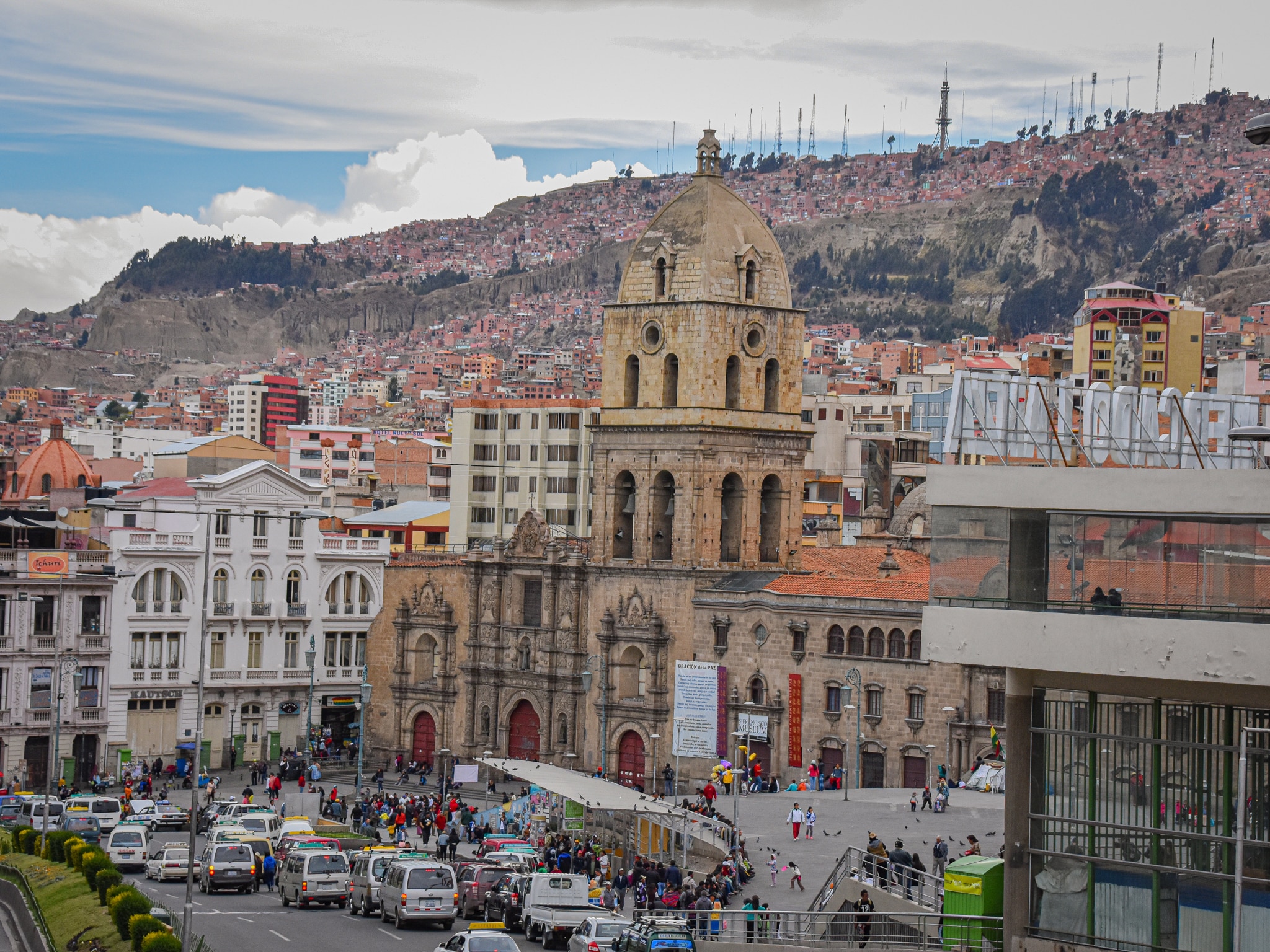
Sadly, I only managed to spend a few days n the capital city, La Paz. Whilst I wasn't overly thrilled with the city, there was something that made me want more.
Why Bolivia?
Backpacking Bolivia is still seen as a bit of an enigma, a new thing, and something most haven't considered. Why is that?
Unlike the tourist trails of South East Asia, Bolivia feels like a further step into the unknown, riskier if you will. That can and does put people off, which therefore makes backpacking Bolivia a true backpacking/travellers experience.
You hear the phrase 'off the beaten track' well if that is what you want, look no further than Bolivia. It's raw, it's rugged, and it makes no apologies for what it is.
Bolivia beckons you with the thrills and exhilaration of death-defying and adrenaline activities. Therefore, if you would class yourself as someone looking for something 'that bit different' or looking for a real story, backpacking Bolivia is something you need to consider.

Quick Stats
Currency
Bolivian Boliviano
Religion
Christian: 87%
Population
11.6 million
Language
Official: Spanish
Also: Guarani
When to Go
High Season: May - Oct
Low Season: Nov - April
Price of Beer
£1.70 a Pint
Our Bolivian Stories
La Paz, Bolivia – A Travel Guide
La Paz, Bolivia – A Travel Guide | Written by Greg Heads up: We sometimes work with companies to provide affiliate links and reviews – here’s what that means. If it’s here, we use it. We don’t plug shit for profit. Houses on the Hill Founded in 1548 La Paz is […]
Contents
Where To Visit
La Paz
La Paz is a complex mix of culture, colour and design. Yet it is poverty-stricken, and often found crumbling within its very existence.
The dividing lines of the rich are poor may as well be drawn across the pavement they are that obvious. Both, however, have a remarkable ability to make you smile. Both have glimpses of beauty and hope.
My overall impression was one of shock. The city is built within the mountains and feels like a vast prison fenced off from the outside world.
It does, however, have that buzz a city should have. It has character and excitement, but sadly it just didn't fill me with awe.
Read our full guide to backpacking La Paz here.

Salt Flats
Salar de Uyuni to the south-west of Bolivia showcases the worlds largest salt flats just west of the town it's named after. The salt flats stand at a staggering 10,582km squared (around 4,000 miles squared).
The salt flats themselves play host to several amazing events, including 4x4 driving experiences, salt-boarding, cactus island, see the stars in all their glory and of course relax in the hot salt springs.
Be it a day trip or an overnight stay you are sure to enjoy your time amid this fascinating salty moon-like land, where trains have come to rest, and flamingos come to thrive.
Santa Cruz
Santa Cruz is, by population, Bolivia's largest city with a population of around 2.3 million people. The city is one of, if not the, most important in Bolivia with its wonderful mix of old Spanish and Bolivian facades and modern styles. It has business and investment at its core and ever-growing population who flock to the area for its nightclubs, bars, restaurants and skyscraper offices.
It is located on the banks of the glorious Piray River which runs through the west of the city, and fairly centrally in the country.
El Alto
With nearly 1 million inhabitants, the city of El Alto stands over the capital La Paz to the west of the country, yet to the east of Lake Titicaca.
Having driven through it, I wouldn't advise going anywhere near it, it looks like a poorer version of La Paz, with endless redbrick half-built properties, half of which are covered in a shabby tin-like roof. Crime is higher here and there isn't much in the city bar the airport.
Cochabamba
With a youthful and vibrant nightlife, Cochabamba is an exciting blend of contemporary living and cultural heritage with stunning views around the Andean Valley.
The city is known as the home of food and restaurants in Bolivia. It's the place for the younger members of society and is an up and coming forth largest city in the country.
What's It Like Backpacking Bolivia?
Having only spent a few days in the country its hard for me to give a true review of what it's like backpacking Bolivia. I can, however, say I found it shocking. I couldn't help but feel saddened from what I saw.
The sheer amount of poverty and dilapidated buildings with wires dangling from the street corners was frightful to see. It hit me that Bolivia had such impoverished areas when compared to the likes of Peru.
That said, it's not all bad, the people were generally very welcoming and the experience was one that left me humbled, but disappointed, knowing that there is so much more to see. I had probably experienced the worse parts of the country. I'd love to go back, and explore further afield and report back on the beauty within Bolivia
The Accommodation
My experience in regards to accommodation within Bolivia is one of real delight and was a highlight of backpacking Bolivia.
Sadly, since COVID has gripped the continent in 2020 a number of hostels, hotels and homestays in the country have closed, some permanently. Whilst I write this based on my experience, things may have changed during the outbreak.
Sadly, this has happened to the place I stayed, Hotel Osira. It was fantastic, the staff were helpful and friendly and the rooms large and extremely comfortable. Amenities were on point and the location was perfect.
I was astounded with the level of comfort for the price. Whilst you can spend big, you really don't need to. You can have it all for very little. I am sure accommodation changes as you move around the country, but I cannot tell you about that at this time. To check out the rest of the accommodation check out Airbnb.
Hopefully, we will be back in South America very shortly, COVID dependant, and be able to update you further on this subject.
Check our detailed accommodation guides for:

The Food
Again, sadly I'm unable to provide you with a full rundown of true classic Bolivian foods. However, along with the accommodation, this was a shining light in the dark and dismal world of backpacking Bolivia.
The fresh fruit markets are awash with excitement (unlike, the sleeping saleswoman in the photo), noise, colour and smell. It really is a grand unveiling, to not only the foods and shopping but a way of life for those living within Bolivia.
The foods on offer at the fresh fruit markets are unbelievably cheap. Luckily, if you were hoping for a little more than fruit, there are vast numbers of food markets and food halls too. As with the fruit markets, these halls are phenomenally cheap, and you can pick up mouthwatering meals for next to nothing. I highly recommend giving them a go. You'll find local recipes and fantastically tasting Bolivian delicacies that you won't find elsewhere.
With cheap ingredients and fruits on offer throughout the markets and halls, it will come as no surprise that meals out are also well-priced.
Whilst, like Peru, the food has been heavily based on meat and vegetables, namely, pork, potato, corn, beef and chicken, there is also a heavy Spanish influence. Meals change as you meander around the country with differing styles, tastes and ingredients.
Alongside the Bolivian and Spanish classics, Asian restaurants and meals are prevalent throughout. I must say they are stunning too.

The Culture
Bolivia may not be known for its culture, dance, food or traditions. Nevertheless, once you scratch the surface, you will discover a world of creativity, music, history and diversity.
Whilst backpacking Bolivia you will discover that culture and heritage are an important way of life to the Bolivian people.
One of the first things you will notice, in certain parts of the country, is the clothing. Much like Peru, clothing tells a story of where the person's family originates. Therefore you will encounter many styles throughout your experience backpacking Bolivia. The traditional Andean women will often be found wearing a bowler hat, and a frilly dress known as a pollera accompanied by a colourful shawl. The men would wear a woollen cap called a chulla, cotton trousers, and a bright colourful poncho.
Other regions such as Potosi and Chuquisaca tend to have a more Incan design whilst other regions don the more Spanish styles to name a couple.
Other parts of Bolivian culture is as interchangeable as the clothing. Therefore, if anyone describes Bolivian culture in one word, they really do not know what they are talking about. Festivals, music and dance play a big part in the Bolivian way of life and depending on what part of the country you visit, you will discover numerous styles, sounds, and atmospheres. However, there does appear to one common theme throughout Bolivian music, and that is the use of wind instruments, be it panpipes, or one of my styles of flutes.

The Transport
Luckily for me, but not so great for the Backpacking Bolivia blog, I didn't use public transportation at all, bar the journey from Peru to the capital.
From what I saw, there were a vast number of small buses called Micros and Trufis, as pictured below. They seemed small, beat-up yet plentiful, and never overcrowded. This was my only real experience with public transport in Bolivia.
Taxis are also two to the penny. Still, you must be careful, and always use official taxis which you have booked over the phone. Unofficial taxis are the source of a lot of robberies and kidnap in Bolivia. Many people in Bolivia use their cars as taxis to enhance their income without a licence.
For the more prolonged journies throughout Bolivia, the smaller Trufis will not suffice. Thus, you'll need to jump aboard the larger public buses. Once out of the main cities, the roads go from bad to worse. Which, unfortunately, means a bumpy and longsome drive. These drives can be halted at any moment by conditions, road surfaces or protests, which is not ideal, especially when you need to get somewhere quickly, say a connecting flight.
Your other options are trains or flights, which again, are a mixed bag in themselves.
There main international airports in Bolivia centre around the main tourist hotspots of Santa Cruz, Cochabamba and the largest Airport in Bolivia in El Alto. El Alto International airport services the capital La Paz, and the surrounding area. Fun Fact; It is also the reason that there are no tall buildings in El Alto.
Trains, whilst more comfortable, are not without their problems. The lines are limited and can often be a pricey way of travelling across Bolivia.

The Budget
As you will discover, backpacking Bolivia can be an extraordinarily cheap experience. You will, at times, have to consider safety within your budget. There is no point being able to afford a safer location, but not spend it and fear being mugged in an unsafe location.
Similarly, there is no point in flashing the cash and living excessively as you'll make yourself a target.
So without further ado, our three Far Out budgets are;
The 'Backpacker' Budget
Your only objective is to keep travelling. The secret? Keeping costs at an all-time low. This is the budget for you.
Accommodation - Accommodation varies massively across the country, with differing styles, standards and ultimately, pricing. The cheapest you will find comes in at around 27BS (£3). Even then, they are very sparse. In reality, you will need to be budgeting around 45BS (£5) a night. You will find these rooms extremely basic and cramped, but that's what you expect for a few quid a night.
Foods -As mentioned, you will find a lot of markets and food halls across the main towns and cities. They are often amongst the cheapest places to eat. Other options include the local cafes and restaurants away from the main tourist hotspots. If you have what is known as the almuerzo (set menu), you can often eat for as little as 13BS (£1.50). Breakfasts come in cheaper, whilst an evening meal could easily be double that price. Therefore, a daily budget, including three meals would come in at around 45BS (£5).
Transportation - Backpacking Bolivia can be done on a very reasonable budget, however, you get what you pay for. The ride will be spine-breakingly uncomfortable from start to finish. Although I would still suggest, where possible, you walk. This, obviously isn't an option for crossing the country, you will, at some point, have to catch a public bus. For reference, a bus from La Paz to Tarija, in the south-east 553miles (890km) will cost you 259BS (£28.50). This sort of journey will be a one-off, as it crosses the entire country. Therefore if we go for a daily budget for transportation of 45BS (£5) a day, that should see you comfortably through.
Drinks - As a backpacker looking to save as much as possible, you will be confined to drinking local beers. The best place to find them is in the markets, where you can pick up a pint for around 15BS (£1.60). Restaurants and cafes will charge considerably more. A couple of beers from the market sounds like a winning combo on your budget so, 30BS (£3.50) a day on drink will suffice.
Overall - Your backpacker daily budget for Bolivia, including three meals, will come to a total of 165BS (£18.50).
The 'Travellers' Budget
You've saved for this trip, and you want the ultimate bang for your buck. Money is tight, but you want the best experience. We've got you covered.
Accommodation - It is countries like Bolivia where you extra buck goes a long way. With the extra cash, you can expect a few more basic amenities and a lot more space, be it personal or generally within the dorms. Not only that, but you'll have a much wider range of properties to choose from. These options start to present themselves in better locations too, all for a fantastic 89BS (£10) a night.
Restaurants - Much like the backpackers budget, I suggest you save your money at mealtimes and spend it better elsewhere. The local markets, food halls and 'locals' restaurants cook up a storm and therefore are still the best for your budget. You have the disposable cash to allow yourself a decent meal in a better quality restaurant, a couple of evenings a week. Just don't make a habit of it. Overall, I will say a decent daily budget on food would come in around 90BS (£10).
Transportation - As mentioned numerous times within the blog, transportation throughout Bolivia will never win any awards. No matter how much you polish a turd, it will not turn to gold. Ideally, I would say spend your extra cash here and save your spine. However, sadly, I cannot. For the same journey (La Paz to Tarija) that costs the backpackers £28 on a bus, would cost nearly 720BS (£80) to fly. Yes, you save 12 hours, and yes your bones will still be where they should be, but at over £50's extra per journey, is it worth it?
Thus, the only change to the daily budget will be the odd short scoot around town in a Micro to save your legs. Therefore, your daily budget for transport in Bolivia is 65BS (£7).
Drinks - As with most of the blogs I write, the alcohol section seems to be where you, the travellers, gain over the backpackers. You can afford the odd night club or a couple of beers at a restaurant, whilst also enjoy the cheaper local beers from the markets. As you'd expect, alcohol within the nightclubs will cost you more than at a bar, which, in turn, is more expensive than the markets. You have saved for this experience, knock yourself out and go crazy from time to time.
If anywhere, this is where you'll want to flex that muscle, let's budget a healthy 135BS (£15) a day.
Overall - Your travellers daily budget for Bolivia, including three meals, will come to a grand total of 379BS (£42).
The 'Daddies Credit Card' Budget
Your trust fund is finally available, and your Instagram followers need to see where you are in the world this week. You farted the other day, and a private jet came out. We haven't forgotten you.
Hotels - Ok you gods and goddesses, I'm not sure if you have ever considered places like Bolivia, but let's see what we can do for you. I doubt we will be able to blow your budget here, but we can try and give that rowdy trust fund a hard shoeing. Hotels may never, in fact, meet your impossible standards, you will not find that same level of perfection Jeeves offers at home. It's Bolivia.
The best I can offer is 1170BS £130 a night, which I know, is nothing for you, but I think you'll do well to spend more than that per night.
Restaurants - Bolivia does fine dining and on a budget suitable for more than the celebs. Due to this, you will notice a few of us common folk spoiling your views. Sorry, not sorry. That said, you will do well to waste, sorry throw more than 300BS (£33) on a meal in Bolivia. Not that you may have heard of a budget before, but if we give you a daily budget for the three meals of 600BS (£67), you shouldn't starve.
Transportation - I have just googled private jets, and you're in luck. There are numerous companies out there who will fly you around Bolivia, but this can come at a cost. Not that you care. We are talking up to 134,765BS (£15,000) an hour. So it's out there if you need it. However, if you are just super-rich, and aren't Jeff Bezos or Bill Gates then maybe you'll have to settle for a standard charter flight.
As mentioned in the travellers budget, La Paz to Tarija on a bus costs 250BS (£28), which you have to avoid. For you, it's totally worth spending 720BS (£80) to fly. It's quicker, more comfortable, and honestly, it's just better.
Therefore along with private drivers to get you around the city, costing about 10BS a kilometre, our daily budget will be a grand 224BS (£25)
Drinks - Whatever you want is on offer. You've saved money on accommodation, food and if truth be told, you've not spent an awful lot on transportation either. Let your hair down and have a night out. You should be looking at the fine wines, such as the 2016 Icono Tempranillo. Whilst it may cost you more than your meal, it sounds like what you've been missing out on. A drop in the ocean at 800BS (£89). A couple of cheeky nightcaps on top should see you over the 1,000BS (£111) barrier.
Overall - Your daddies credit card daily budget for Bolivia, including three meals, will come to a grand total of 2,994BS (£333) a day.
The Best Things To Do When Backpacking Peru
The Witches Market
Whilst there are several excitable things to do in Bolivia, as always we only talk about things we've done. That way, we stay honest and reliable.
The number one spot for tourists in the Bolivia capital, La Paz, has to be the Witches Market. Named after the yatiri (witch doctors) that run them.
It is here that you'll find the weird and wonderful. The markets have everything from potions and fetuses, to nicknacks and clothing.
These magical narrow streets are a fantastic experience, where the small shops will lead you into a strange and wonderful world of shopping. Just be sure to take a good amount of cash as these cave-like shops will intrigue you into purchasing numerous gifts and nicknacks, all of which come with a fascinating story.

Street Art In La Paz
Throughout the capital city, fantastic bright and interesting artworks don the once dull and dreary walls. The artworks depict the history and tradition of the Bolivian people, as well as the wildlife and the nature that surrounds them.
Not only do they tell stories, but they bring joy to the locals and visitors alike.
The bright and beautiful colours bring life to the streets, which if it wasn't for the artwork, would be soulless.
Some of the districts have more street art than others, but no matter where you are in the Bolivian capital, you're never far from a creative masterpiece. See how many you can capture on a walking tour around this cultural and urban delight.

Preparing for Your Trip
Suggested Itineraries
Unfortunately, having only driven through El Alto and visited the capital La Paz, I am unable to advise on itineraries.
Here at Far Out, we will only advise on things we have done, places we have been, and only if we think they are worthy. Therefore I cannot fill in this section for you. It keeps us honest, and we wouldn't want to mislead you at any point.
Speaking Spanish
You are likely to hear several languages when backpacking Bolivia. Local dialect changes with the terrain. Several languages are spoken across Bolivia, including Aymara, Puquina, Kallawaya. Do not be surprised to discover that many people do not speak English in Bolivia. If you are fluent in Spanish, you may still find the occasional village who you will struggle to communicate with. Nonetheless, Spanish is the national language. So, here are a few keywords and phrases to help you through.
| English | Spanish | Greg's Pronunciation Breakdown™ |
|---|---|---|
| hello | Hola | o'la |
| bye | adiós | adi-os |
| my name is... | me llamo | may ya-mo |
| yes | si | say |
| no | no | no |
| ok | okay | o-kay |
| please | por favor | por fav-or |
| thank you | gracias | gra-thii-ass |
| sorry | lo siento | lose-ento |
| how much? | cuanta? - female cuanto? - male | quant-a quant-o |
| excuse me | disculpe | dis-sculp-ey |
| what? | que | key |
Visas and Borders
If you're backpacking Bolivia, you will be pleased to know that for the vast majority, entry into the country will not require a visa.
Citizens from the following countries will be granted a 30 day period visa-free, upon showing a valid passport with 6 months validity, which can be extended to up to 90 days free of charge.
All EU countries, Andorra, The UK, Switzerland, Norway, Lichtenstein, The Vatican, Turkey, Russa, Iceland, Monaco, Israel, Australia, New Zeland, Canada, USA, Mexico, Japan, Philippines, Palestine, Costa Rica, Panama and French Guiana.
Citizens of all South American counties south of Panama, bar Guyana and Suriname will require both a passport and ID card but enjoy the same restriction-free movements.
Citizens fo the following countries will have to gain special permission before attempting to obtain a visa; Cambodia, Indonesia, Laos, Bhutan, Mongolia, North Korea, Iraq, Afghanistan, Pakistan, Angola, Chad, DRC, Libya, Nigeria, Rwanda, Somalia, Sudan, Syria, Timor-Leste and Yemen.
If you are a citizen of a country not mentioned above, you are required to get a visa. You can, however, obtain a visa prior to your arrival for free. If you obtain a visa on arrival you will be charged.
Borders
Bolivia has a number of entry and exit points. There are numerous land borders with its neighbouring countries Peru, Brazil, Paraguay, Argentina and Chile.
The two main entry points with Peru to the west are both on Lake Titicaca, through the border town of Desaguadero and the town of Yunguyo.
The most popular land borders with Brazil to the northeast are through the town of Cobija into the depths of the Amazon Rainforest. Secondly, over the fast-flowing Mamore River which spilt's the jungle town of Guayaramerin and finally through the more easily accessible border town of Puerto Quijarro.
When it comes to land borders with Paraguay, there is only one real option and that is to the southeast at the Canada Strongest crossing.
The small Bolivia-Argentina border has three main crossing points. Firstly, via the Professor Salvador Mazza International Bridge in the Bolivian town of Yacuiba. Secondly, the Aguas Blancas International Bridge in the town of Aguas Blancas. Finally, through the town of Villazon.
Some of the above may well be considered tricky due to the lay of the land, but they pale into insignificance when we look at the Bolivia-Chile border.
The one easy crossing can be found outside the Bolivian town of Tambo Quemado. Outside that option, you will find yourself high in the Andes moving through the snowcapped mountains and salt flats at crossing points such as Pisiga at around 3,700 meters above sea-level. Your other option is outrageous route 27 which crosses to the east of Iglesia San Pedro at nearly 4,500 meters above sea-level.

What to Pack
Backpacking Bolivia is going to require some serious thought when it comes to to the question of what shall I pack?
Much like Peru, this is not an easy task. The rugged terrain causes many issues and unfortunately, you will have to pack for each. That is if you plan on getting down and dirty in Bolivia. You will have to consider the wet and humid Amazon Rainforest to the north, and the snowy Andes to the south, not to mention, the vast desert-like flats sandwiched between.
It's going to be a hefty amount of gear but, done properly, you can save yourself a bit of weight.
So what do you pack?
Firstly, you will need a couple of jackets/coats, one super lightweight, and one thick warm jacket. Both must be waterproof. There is nothing worse than being soaked through, be it in the rainforest or on top of the Andes. We, here at Far Out, think this is where you need to splash the cash. Northface and Regatta are expensive, but there is a reason for that, they are the best.
Secondly, its similar advice when it comes to shoes, keep them sturdy, waterproof. These are crucial whilst backpacking Bolivia, as you will be walking over mountains, salt flats and through the rainforests.
This is, as mentioned, a case of packing for every condition. You will need shorts and t-shirts, as well as a warm jumper, trousers, gloves, hat and scarf.
Finally, it is worth packing a serious first aid kit. Make sure it includes but is not limited to; suncream, bug and mosquito spray, altitude tablets and dioralyte's, it's easy to pick up a bug or become dehydrated in Bolivia, and the altitude will not help your situation.
Travel Insurance
Bolivia has many hidden dangers and is full of fun-packed adrenaline sports. Therefore, as always we recommend you get travel insurance prior to backpacking Bolivia.
Certain activities or excursions will bump up your insurance within Bolivia. It is, however, worth getting the correct package. It wouldn't be much fun injuring yourself on Death Road, only to find out that in the small print you wouldn't be covered for that journey. We recommend you speak to your insurers or read the small print.
Travelling Ethically
Bolivia has always been a relatively poor country and has been embroiled in countless wars, both internally and externally. When mixed with the illegal production of cocaine and poaching the country has been close to collapse on more than one occasion. The more you understand about the struggling political and international relations, the better placed you will be to travel more ethically whilst backpacking Bolivia.
Therefore, if you're thinking of how best to ethically travel Bolivia, your first consideration should be; poverty. Do not show off your wealth, do wear an expanse of expensive jewellery or your keep a wadge of cash on display. When haggling at the markets, remember to do it with respect and a smile. Never accept the first price, but at the same time, do not fight the merchant for a couple of pennies. Those pennies could be the difference between going hungry or feeding their family.
Secondly, Bolivia, along with the more northerly, South American countries, is blessed with the magical Amazon Jungle. This is something we all need to concern ourselves with, whether we end up backpacking Bolivia or not. Deforestation thanks to farming, palm olive oil and timber production is destroying this habitat at a ridiculous rate. The WWF is reporting that around 27% of the Amazon will be without trees by the year 2030. This simply has to stop.
The wildlife and the scenery within the Amazon and Bolivia as a whole, are sensational. Be it, the jaguar, the giant otter the flamingo or the trees themselves, we must protect this rich biosphere. Without it, we will lose countless species and endanger our own.
Sadly, tour companies still promote, as they do in Thailand, photos with dangerous animals. The animals are drugged and this is a dick move. If this is something you are interested in, please fuck off. We don't want you on our site. Do not use unofficial companies or those promoting illegal or cruel tours.
Bolivia has an ever-growing understanding of conservation, rehabilitation and sustainable living. Projects across the country are continually popping up and teaching is now taking place within the country. There is a long way to go, but times are slowly changing in Bolivia. Join one of these conservation groups, stay with locals within the community-run lodges.
Respect your environment, the people and the wildlife.
Safety
Backpacking Bolivia is somewhat of an anomaly. Crime is rife throughout the country, especially within the main tourist destinations, and even-more-so during busy markets and gatherings.
Drugs - Bolivia is awash with drugs and illicit substances, which isn't much of a surprise when you consider it is the third-largest producer of cocaine in the world. Production or trafficking illegal substances will land you a minimum sentence of 8 years in prison. That is not something you want in Bolivia.
The majority of crime in Bolivia is minor, such as pickpocketing and theft. Nevertheless, violent crime is on the rise throughout Bolivia. Assaults and kidnaps are becoming a growing issue, especially in parts of the capital.
The kidnaps are often quick and violence will be used. You'll be taken to a cash machine to withdraw the maximum amount of money and released. Occassionally these crimes can be prolonged, but this is very rare.
Criminals often impersonate taxi drivers, police officers or other officials to game your trust. If something doesn't seem right phone the tourist police to check the person you are dealing with is kosher on 0800 14 0081. It is a free-phone number from anywhere in Bolivia.
The old Far Out rule is, as always, be vigilant and sensible. Don't go out alone after dark in areas you do not know. Be aware of your surroundings especially when using cash machines. Always phone and use official taxis as that is where you're likely to become a victim of crime. Do not carry unnecessary amounts of cash, and always keep your passport and flight tickets safely locked away.
Brief History
Discovery of plants, jewellery and tombs date evidence of humans living in Bolivia as early as 10,000BCE.
It is believed that the Wankarani people were among the first groups to settle in Bolivia, around the shores of Lake Titicaca. They dominated the area from around 1,800BC until the Tiwanaku empire developed around 400AD, although, they themselves had been in the area for many hundreds of years. Again living just southeast of Lake Titicaca. The Tiwanaku people were thought to be fairly peaceful rulers, and they reign only came to an end around 1,000AD due to climate ruining the crops leading to a demise in the power and ability of the Tiwanaku people.
Over the following few hundred years until 1527 when the Spanish arrived in the region, there was a constant battle between the Aymara Kingdom and the dominant force of South America, the Inca. Despite numerous uprisings, the Inca crushed the Aymara revolution and brought them into the Ina society allowing some traditions to continue.
Even the mighty Inca could only capture the western half of Bolivia, with tribes such as the Mojo's regularly repelling them. Even the Spanish arrival had limited impact on the eastern half of Bolivia. The indigenous Bolivians to the east maintained their way of life throughout these years.
In more recent years the War of the Pacific, 1879-1883 saw Bolivia lose ground to its neighbouring countries. Political and international affairs were at an all-time low and the country grew ever weaker until the 1920s when some form of stability reigned.
Nowadays, there is a democratic system which seemed to be working in Bolivia. That was, until the 2019 elections, which caused the former, and successful leader to flee to Mexico.
Our Bolivian Stories
La Paz, Bolivia – A Travel Guide
La Paz, Bolivia – A Travel Guide | Written by Greg Heads up: We sometimes work with companies to provide affiliate links and reviews – here’s what that means. If it’s here, we use it. We don’t plug shit for profit. Houses on the Hill Founded in 1548 La Paz is […]